
Your landscape talks to you constantly. Most people just don’t know how to listen.
A patch of lawn that never greens up, puddles that sit for days after rain, weeds that come back no matter what you do — none of these things happen randomly. They are symptoms, and every one of them is pointing at something specific going on beneath the surface. Once you know what to look for, your yard becomes surprisingly easy to read.
At IslandEarth Landscape Company, we spend every day working across properties in Victoria, Saanich, Oak Bay, and Langford. Here are the seven most common signals we see Victoria properties sending — and what each one actually means.
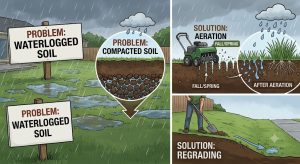
1. Standing Water After Rain = Your Soil Is Compacted or Graded Wrong
If puddles form on your lawn or garden beds after it rains and stay there for hours, your property is waving a red flag. Water should absorb into healthy soil within 30 to 60 minutes of light rain. When it sits, one of two things is happening: your soil is so compacted that water cannot penetrate, or the grade of your property is directing water into a low spot with nowhere to go.
Standing water on top of soil for an extended period means the soil is likely so compacted that water cannot get through to the roots, which need moisture to thrive.
Victoria’s clay-heavy soils are particularly prone to compaction. Heavy foot traffic, lawn equipment, and even intense rainfall can press soil particles together tightly, squeezing out the pore space that water, oxygen, and nutrients need to move freely. Aeration in spring or fall opens those pathways back up. For persistent pooling caused by grading issues, the fix involves regrading the affected area to redirect water away from the problem zone.
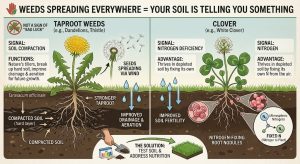
2. Weeds Spreading Everywhere = Your Soil Is Telling You Something
Dandelions, plantain, and clover spreading aggressively through your lawn are not a sign that you have bad luck with weeds. They are a sign that your soil conditions are favouring them over your grass.
When taproot weeds like dandelions and thistle spread across a lawn, compaction is often the cause. Nature uses these plants to break up hard layers — their strong roots penetrate compact soil to improve drainage and aeration for future growth. In other words, the weeds are doing your lawn a favour. The problem is the soil, not the plants.
Clover specifically is a sign that your lawn is nitrogen-deficient. Clover fixes its own nitrogen from the air, giving it a competitive advantage in soil that has been depleted. Rather than repeatedly pulling clover out, testing and addressing soil nutrition gets to the actual issue.
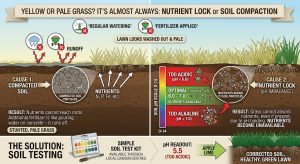
3. Yellow or Pale Grass Despite Regular Watering = Nutrient Lock or Compaction
You water. You fertilize. The lawn still looks washed out and pale. This one frustrates a lot of Victoria property owners, and it almost always comes down to one of two causes: the nutrients cannot reach the roots because the soil is compacted, or the soil pH is off and the grass cannot absorb what is there.
Compacted soil restricts the movement of nutrients, making it difficult for grass to absorb them even when fertilizer has been applied. Adding more fertilizer to compacted soil is like pouring water on concrete — it runs off rather than getting to where it needs to go. Lehighvalleylawn
A simple soil test, available through local garden centres, will tell you exactly what your pH is and what amendment is needed to correct it. Most Victoria turf performs best in soil between pH 6.0 and 7.0. Outside that range, nutrients bind to soil particles and become unavailable to plants regardless of how much fertilizer you apply.
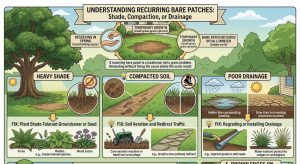
4. Bare Patches That Keep Coming Back = Shade, Compaction, or Drainage
A bare patch that you reseed every spring and that comes back bare every fall is not a grass problem. It is a location problem. Something about that specific spot is making it impossible for grass to establish, and seeding over it without fixing the underlying cause will produce the same result indefinitely.
When soil is compacted, plants struggle to grow evenly. Bare spots appear where roots cannot spread or dig deep enough to find water and nutrients. Helicon
The most common culprits on Victoria properties are heavy shade from established trees, compacted soil from foot traffic along informal pathways, and drainage that keeps that spot wetter or drier than the surrounding turf. Fixing the right cause — whether that is aeration, a pathway redirect, or switching to a shade-tolerant species or groundcover — is the only thing that produces a lasting result.
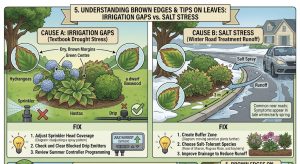
5. Brown Edges on Shrubs and Leaves = Irrigation Gaps or Salt Stress
When the edges and tips of leaves on shrubs and garden plants turn brown while the centre of the leaf stays green, that is a textbook sign of drought stress or inconsistent irrigation. The edges of a leaf are the last place water reaches, so they show moisture deficiency first.
On Victoria properties near roads, salt stress from winter road treatment can produce the same symptom on plants within range of spray or runoff. If your brown-edged plants are all within a few metres of the road and the pattern appeared in late winter or early spring, salt is the more likely cause than irrigation.
For irrigation-related browning, the fix is usually adjusting head coverage, checking for blocked emitters on drip lines, or reviewing how your controller zones are programmed. Brown edges appearing in late July and August on properties with irrigation suggest that summer scheduling has not kept pace with increased heat and plant demand.
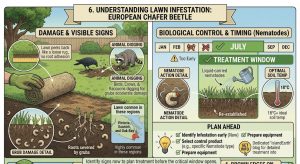
6. Lawn Peeling Up Like a Carpet = European Chafer Beetle
If you can roll back sections of your lawn like a loose rug, revealing a layer of white grubs underneath, you have a European Chafer Beetle infestation. The grubs feed on grass roots through spring, severing the lawn from the soil beneath it and leaving it with nothing to hold on to.
This is one of the most recognizable and common lawn problems across Victoria, Saanich, and Oak Bay. Birds, crows, and raccoons accelerating the damage by digging for grubs are often what draws a property owner’s attention first.
The treatment window for nematodes — the most effective biological control available under BC’s pesticide regulations — is narrow, typically a short period in July when soil temperatures are right. If you are seeing the signs now, the time to plan your treatment approach is before that window opens, not after. IslandEarth has a dedicated blog post covering chafer beetle identification and treatment in detail.
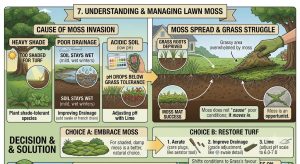
7. Moss Taking Over Your Lawn = Drainage, Shade, or Acidic Soil
Moss does not cause poor lawn conditions. It moves in because the conditions are already poor for grass. If moss is spreading across your lawn, your grass is losing the competition for one or more of these reasons: the area is too shaded for turf to thrive, the drainage is poor and the soil stays wet, or the soil pH has dropped below what grass can tolerate.
In Victoria, all three conditions are common. Our mild, wet winters create perfect moss conditions, and clay soils hold moisture longer than turf roots want. Rather than fighting moss with lime and raking year after year without addressing the underlying cause, it is worth deciding whether grass is actually the right choice for that spot.
For shaded, damp areas, moss can be a better choice than grass. For areas you genuinely want as turf, aerating compacted soil, improving drainage, and adjusting pH with lime application will shift conditions back in grass’s favour.
Your Yard Is Already Giving You the Answers
The most common landscape problems on Victoria properties are not random. They follow patterns, and those patterns point directly at specific fixes. Learning to read what your property is telling you saves money, saves time, and gets results that last — because you are fixing the actual problem rather than the symptom.
If you are seeing any of these signs on your property and want a professional read on what is causing them, IslandEarth Landscape Company offers assessments across Greater Victoria.
Contact us today to schedule a consultation.
📍 Serving Victoria, Saanich, Oak Bay, Langford, and surrounding communities
🌐 IslandEarth website
📞 (250) 474-1003