
Most commercial property managers in Greater Victoria know they should stay on top of maintenance. The challenge is that the consequences of not doing it are invisible — right up until the moment they aren’t.
The biggest problem with neglecting commercial property maintenance is that the damage doesn’t announce itself immediately. It builds quietly in the background, often going unnoticed until it becomes expensive and urgent. What starts as a small issue — like an overgrown hedge or clogged drainage — can escalate into structural damage or safety hazards.
At IslandEarth Landscape Company, we provide commercial landscape maintenance and property maintenance services — including street sweeping and exterior upkeep — across Victoria, Saanich, Oak Bay, and Langford. We see the same pattern on neglected properties every year. Here is what ignoring regular maintenance actually costs you, in concrete terms.
The Liability Problem Is Real and It Is BC Law
This is the cost most property managers underestimate until it lands in their inbox as a legal claim.
The BC Occupiers Liability Act requires property owners and those who control a space to take reasonable steps to keep people safe. It applies to parking lots, driveways, exterior staircases, sidewalks adjacent to the property, and any outdoor space where the public or invited guests may be present.
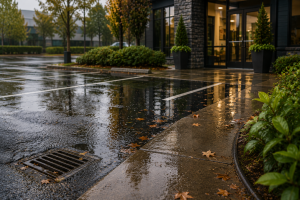
BC’s climate — frequent rain, dampness, and freeze-thaw conditions — makes many surfaces dangerous. Moss growing across a parking lot entrance, debris collecting near building entrances, standing water turning to ice overnight — these are not just aesthetic problems. They are hazards that a property manager knew or should have known about, and that is the standard courts apply.
Under the BC Occupiers Liability Act, all property owners are legally obligated to keep their premises in a reasonably safe condition for visitors. If they fail to do so and someone is injured as a result, such as during a parking lot slip and fall, the property owner may be held liable.
Liability in these cases often depends on whether the owner knew or should have known of the hazardous condition. When an injury results from one of these hazards, maintenance logs, business records, and warning signage might help prove liability. In other words, documented regular maintenance is not just good practice — it is your legal defence if something goes wrong.
The practical takeaway for Victoria properties: a regular sweeping and maintenance program, with records showing consistent upkeep, is one of the most cost-effective forms of liability protection a commercial property can have.
Deferred Maintenance Compounds — Fast
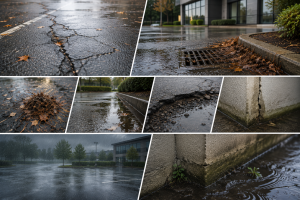
Many maintenance issues begin with minor signs of wear that are easy to overlook. A small crack in a parking lot, a clogged drain, or debris collecting near building entrances may not seem urgent at first.
The problem is that each of these minor issues accelerates the next one. Debris left on asphalt holds moisture against the surface, accelerating cracking and deterioration. Clogged drains create standing water that freezes in winter and softens asphalt in summer. Blocked drainage systems can quickly lead to water pooling around a property. That water doesn’t just sit there — it seeps into foundations, weakens structures, and creates long-term damage that is costly to fix.
Too many buildings still treat maintenance as a repair queue — wait for the complaint, call the trade, pay the invoice, repeat. That approach usually produces more disruption, shorter equipment life, and weaker budgeting.
In Victoria’s climate specifically, the wet season does a remarkable amount of work on neglected exterior surfaces between October and April. Properties that go into fall without cleared drains, swept parking areas, and managed vegetation routinely come out of winter with problems that cost several times more to repair than prevention would have.
Property Value Takes a Hit You May Not See Coming
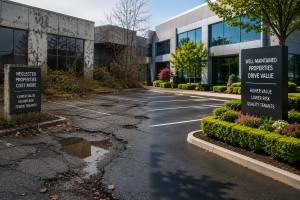
Commercial properties are significant investments, and their value depends heavily on their condition. Neglecting maintenance can lead to long-term devaluation, reducing the property’s marketability and resale value. Potential buyers or tenants are likely to factor in the cost of deferred maintenance when negotiating prices or lease terms, ultimately costing the owner more.
An office building with peeling paint, cracked surfaces, and outdated infrastructure may struggle to attract high-quality tenants. Even if tenants agree to move in, they may demand lower rents to compensate for the poor condition of the property.
For strata properties and commercial buildings in Greater Victoria’s competitive leasing market, this is a real and measurable financial consequence. A property that looks well maintained signals to prospective tenants that management is professional and responsive. A property with debris-filled parking lots, overgrown beds, and stained walkways signals the opposite — and tenants factor that into what they are willing to pay and how long they are willing to stay.
Tenants Notice — and They Leave
Tenant retention is one of the most significant financial outcomes of commercial property maintenance, and one of the least discussed. Finding and onboarding a new commercial tenant costs far more than the difference in lease rate between a well-maintained and a poorly maintained building.
Good commercial property maintenance is not just about fixing what is broken. It is about demonstrating to the people who pay to occupy your building that the property is being looked after — that their business environment is being managed with the same care they bring to running their own operations.
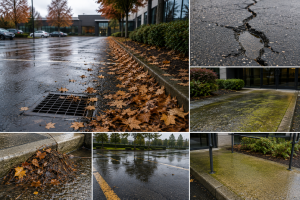
Exterior maintenance is the most visible signal of this. The parking lot, the entrance landscaping, the walkways, and the general condition of the grounds are what tenants, their clients, and their employees see every single day. A building that stays clean, well-swept, and well-maintained communicates pride of ownership. One that doesn’t communicates the opposite.
In strata residential buildings the same principle applies to residents. BC strata governance requires maintenance plans for most strata corporations, and properties that defer exterior upkeep consistently face resident complaints, council disputes, and in some cases regulatory consequences through the Strata Property Act.
The Specific Risks of Neglected Parking Lots and Exterior Surfaces
Parking lots and paved exterior areas deserve specific attention because they carry the highest combination of liability risk, deferred maintenance cost, and daily visibility of any commercial exterior surface.
Victoria’s climate creates a predictable maintenance cycle for paved surfaces. Fall leaf accumulation holds moisture and promotes surface deterioration. Winter rain saturates any existing cracks and accelerates them through freeze-thaw expansion. Spring brings the full picture of what the wet season has done. Properties that sweep and maintain through fall and winter arrive in spring with far less damage to address than those that defer until it is obvious.
Beyond pavement, exterior walkways accumulate the moss and organic growth that Victoria’s wet climate produces reliably every year. Frequent rain turns moss and algae into slick, invisible hazards. Identifying these risks early through regular surface inspections is the best way to prevent slip-and-fall claims.
Regular sweeping removes the debris and organic material that feeds moss growth before it establishes. Once moss is established on a walkway or entrance, removal is more labour-intensive and the surface typically requires treatment to prevent rapid regrowth. Prevention costs a fraction of remediation, and the liability exposure in between is real.
What a Regular Maintenance Program Actually Looks Like
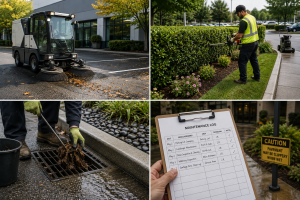
For commercial properties across Greater Victoria, a structured exterior maintenance program typically includes:
Regular parking lot and surface sweeping. Removing debris, organic material, and grit before it damages surfaces or creates slip hazards. Frequency depends on the property’s traffic and surrounding environment — high-traffic retail sites and properties near mature trees need more frequent attention.
Commercial landscape maintenance. Turf mowing, hedge trimming, garden bed edging and weeding, and seasonal clean-ups keep the property’s exterior looking professional year-round and prevent vegetation from encroaching on paved areas, drains, or building access points.
Drain clearing and monitoring. Victoria’s fall and winter rain events move large volumes of water across commercial surfaces quickly. Clear drains are not optional — they are a basic functional requirement that protects both the surface above and the structure below.
Documented service records. Every maintenance visit should be logged. In the event of a liability claim, documented proof of regular upkeep is the most important thing a property manager can provide. Maintenance logs, business records, and warning signage can help prove that an occupier took reasonable care of their property.
The Math Is Not Complicated
Preventative commercial property maintenance costs money. So does reactive emergency repair, liability settlement, vacancy from tenant departure, and property value decline. The difference is that preventative maintenance is predictable, budgetable, and keeps every other cost on the list from materializing.
Preventative maintenance may require ongoing attention, but it is almost always less expensive than repairing significant damage after it has occurred.
For commercial property managers and strata councils across Greater Victoria looking for a single company to handle exterior landscape maintenance and property sweeping, IslandEarth Landscape Company provides both — meaning your grounds and your paved surfaces are managed together, on schedule, with documentation.
Contact us today to talk through what a maintenance program looks like for your property.
📍 Serving Victoria, Saanich, Oak Bay, Langford, and surrounding communities
🌐 IslandEarth website
📞 (250) 474-1003