
Victoria winters are not brutal by Canadian standards, but they are nothing either. Six months of persistent rain, the occasional cold snap, saturated soil, and wind off the water can do surprising damage to landscapes that weren’t prepared before the season turned.
The good news is that winterizing a landscape in Victoria is not complicated. It is mostly a matter of timing — doing the right things in October before the wet season takes over, rather than discovering in February what you should have done in fall. At IslandEarth Landscape Company, this is one of the busiest periods of the year for our crews across Victoria, Saanich, Oak Bay, and Langford. Here is exactly what needs to happen before winter arrives.
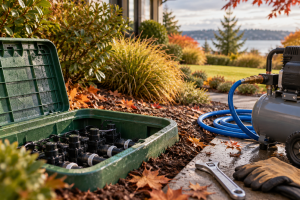
1. Shut Down and Winterize Your Irrigation System
This has a hard deadline. Irrigation lines left full of water through a cold snap will crack, and Victoria does get overnight freezes, usually in December and January, sometimes earlier. A cracked line or damaged fitting discovered at spring startup is a frustrating and entirely preventable repair bill.
Shut off the water supply to the system, drain the lines, and blow out any remaining water with a compressor. The exact process depends on your system — some have manual drains, others need a blow-out through the valve manifold. If you are not sure how your system is set up, hand this job off to a professional rather than guessing.
For commercial properties, document the shutdown date and confirm all zones have been cleared. Spring startup inspections go faster and turn up fewer surprises on systems that were properly winterized the fall before.
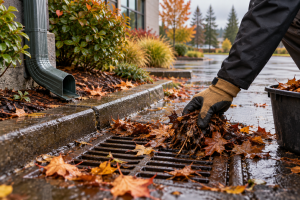
2. Clear Drains Before the Rains Hit
October is when Victoria’s drainage systems earn their keep. Leaves, debris, and organic material that accumulated through summer and early fall can block catch basins, surface drains, and downspout outlets when they are needed most.
Walk the property and clear anything that has built up around drain openings. Check that downspouts are directing water away from the foundation rather than pooling against it. For commercial properties with parking lots and paved surfaces, clearing drains before the wet season is part of basic liability management — blocked drains create standing water that freezes overnight and becomes a slip hazard by morning.
This takes about an hour on most properties and prevents the drainage backup that can damage foundations and paved surfaces over a wet winter.
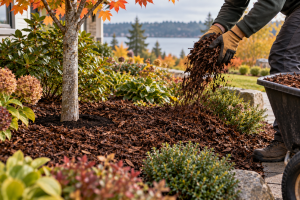
3. Mulch Garden Beds Before the Ground Gets Saturated
A layer of mulch applied to garden beds in fall does three things through winter. It regulates soil temperature, protecting roots from freeze-thaw cycles. It retains soil structure against the compacting effect of heavy rainfall. It also suppresses early weed germination that starts in Victoria’s mild winters as soon as bare soil sits in the rain long enough.
Apply mulch at a depth of 7 to 10 centimetres across garden beds, keeping it pulled back from the base of shrubs and tree trunks. Mulch piled against bark traps moisture and creates ideal conditions for rot and fungal disease through the wet months — a clear ring around each plant base prevents this.
Wood chip mulch breaks down slowly and improves soil organic matter over time, making it the best choice for established beds. For annual beds that get turned over in spring, a lighter composted material works well and adds organic matter directly into the soil as it breaks down.
4. Cut Back the Right Things — and Leave the Rest
Fall cleanup is a balancing act. You want the property looking tidy going into winter, but cutting everything back at once strips the garden of the structure and habitat it provides through the colder months.
Plants that have finished blooming and are showing disease or pest pressure should come out cleanly and go in the garbage rather than the compost. You can cut soft-stemmed perennials that have died back to the ground. Ornamental grasses, echinacea seed heads, and rudbeckia should be left standing — they provide visual structure through winter, and their seed heads are a food source for birds through the colder months. Cut these back in late February just before new growth begins.
For hedges, a final trim in October encourages a last burst of growth that firms up before winter, keeps the shape tidy through the season, and removes the loose, floppy new growth that catches heavy wet snow and can break branches. Victoria does not get frequent snow, but when it does, untrimmed, overgrown hedges often suffer.

5. Protect Tender Plants Before the First Cold Snap
Victoria’s winters are mild enough that most established plants handle them without help. But there are exceptions — plants at the edge of the zone’s hardiness range, recently planted material that hasn’t yet developed a root system deep enough to buffer temperature swings, and container plants fully exposed to cold from all sides, including the bottom.
Lavender, tender ornamental grasses, tree ferns, and some of the more exotic broadleaf evergreens common in Victoria gardens all benefit from a light covering of burlap or frost cloth during any genuine cold snap. The covering isn’t meant to be permanent — put it on when temperatures drop below minus four or five Celsius, and remove it once things warm back up.
Container plants are the most vulnerable and the easiest to protect. Move anything in a pot that is at the edge of hardiness into a sheltered spot against the house or into a garage or shed for the coldest months. Terracotta pots in particular can crack from freeze-thaw expansion when left full of wet soil through a cold winter.
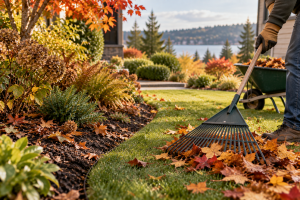
6. Rake Leaves Off the Lawn — But Not Necessarily From the Beds
Leaves left matted down on a lawn through a wet winter create the kind of dense wet layer that promotes fungal disease, smothers grass, and leaves bare patches to deal with in spring. Rake them off the turf and either compost them or run them over with a mower to chop them into smaller pieces that break down faster.
Garden beds are a different situation. A light layer of fallen leaves in a garden bed acts as insulation and adds organic matter, and many beneficial insects and beetles overwinter in leaf litter at the soil surface. You do not need to strip every leaf out of every bed — just enough to prevent a thick smothering layer from forming over plants that need light to come through in spring.
For commercial properties where appearance matters consistently through winter, a leaf cleanup schedule through October and November keeps things looking maintained without requiring a single large cleanup effort at the end of the season.
7. Get Your Tools and Equipment Ready for Storage
Garden tools left outside through a wet Victoria winter come out in spring rusty, corroded, and in some cases beyond saving. Before you put everything away, clean soil and plant material off metal surfaces, wipe blades lightly with an oiled rag, and store tools somewhere dry.
For irrigation equipment — backflow preventers, controllers, any above-ground components — confirm everything is properly protected or removed before temperatures drop. Hoses left coiled outside through winter develop cracks at the fittings and along the body from repeated freeze-thaw cycling. Store them coiled loosely in a shed or garage where they will not freeze.
Remove batteries from battery-powered equipment and store them somewhere that stays above freezing. Batteries left in cold equipment through winter lose capacity faster and can, in some cases, be permanently damaged by repeated deep cold exposure.
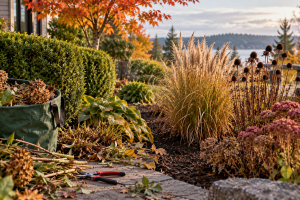
8. Do a Property Walkthrough While You Can Still See Everything Clearly
This is the step most people skip and most consistently regret. Before the leaves are fully off the trees, before the rain makes everything miserable to walk around in, do a proper walkthrough of the property and note everything that needs attention.
Cracked or shifting paving. Fence posts that are leaning. Drainage that looked fine in summer but pooled water after the first fall rain. Tree branches that are crossing or rubbing against the house. Garden beds with plants that clearly did not make it through summer. Retaining walls with sections that have shifted or settled.
None of these things get better over winter on their own. Some of them actively get worse. Catching them now, when conditions are still reasonable, means you can decide what to address before winter and what can wait for spring — rather than discovering all of it at once when the weather breaks in March and your spring schedule is already filling up.
IslandEarth Handles Fall Cleanup and Winterization Across Greater Victoria
If your commercial property or strata complex needs fall cleanup, irrigation winterization, or a professional walkthrough before winter, IslandEarth Landscape Company is scheduling fall maintenance visits now across Victoria, Saanich, Oak Bay, and Langford.
Contact us today to get on the schedule before October fills up.
📍 Serving Victoria, Saanich, Oak Bay, Langford, and surrounding communities
🌐 IslandEarth website
📞 (250) 474-1003