
Victoria is not like other cities. It is home to over 140 species of birds, ancient rainforests within city limits, and wildlife encounters that most urban Canadians would consider extraordinary — and here they happen in your backyard on a Tuesday morning. Tourism Victoria
But the wildlife showing up in your yard is not random. Every visitor — whether it is a hummingbird hovering at your garden bed or a crow tearing up your lawn at 7am — is responding to something specific about your landscape. Once you know what each one is reacting to, your yard becomes a genuinely fascinating place to pay attention to.
At IslandEarth Landscape Company, we work across Victoria, Saanich, Oak Bay, and Langford every day. Here is what eight of Victoria’s most common wild visitors are actually telling you about your property.
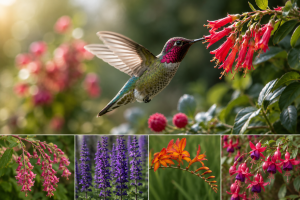
1. Hummingbirds: Your Garden Has Something Worth Coming Back For
If a Rufous or Anna’s hummingbird is making regular visits to your yard, your garden is doing something right. Hummingbirds are extremely selective about where they feed and are drawn to tubular flowers in red, orange, and pink — Red-Flowering Currant, Salvia, Crocosmia, and Fuchsia are all Victoria favourites that hummingbirds cannot resist.
An Anna’s Hummingbird is actually a year-round Victoria resident, one of the only hummingbird species in Canada that does not migrate south. Seeing one in January is completely normal here and a genuine point of pride for Victoria gardeners. If they are visiting your yard regularly, you have native or pollinator-friendly plantings that are earning their keep.
To keep them coming back, avoid pesticide use near flowering plants. Hummingbirds feed heavily on small insects as well as nectar, so a garden with active insect life is far more attractive than a sterile, chemically maintained one.
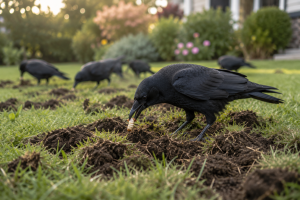
2. Crows Digging Up Your Lawn: You Have a Grub Problem
A mob of crows methodically working across your lawn in the morning is not a coincidence and it is not bad luck. Crows have excellent spatial memory and extraordinary problem-solving ability — if they are tearing up your turf, they have found something worth digging for.
In Victoria, that almost always means European Chafer Beetle grubs. The grubs feed on grass roots just beneath the surface through spring and summer, and crows — along with ravens, starlings, and raccoons — detect them and dig them up with impressive efficiency. The lawn damage from the digging is frustrating, but the crows did not cause your lawn problem. They revealed one that was already there.
If crows are working your lawn regularly, check whether sections of turf lift away easily from the soil beneath. If they do, a chafer beetle assessment and treatment plan should happen before the nematode application window opens in July. IslandEarth has a dedicated post on chafer beetle identification and treatment that covers exactly what to do next.
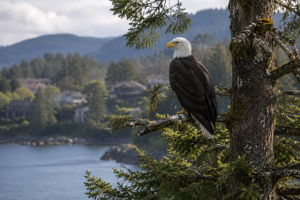
3. Bald Eagles Perching Nearby: You’re Near a Healthy Ecosystem
Bald eagles are not a rare sighting in Victoria — they are a daily presence, soaring above parks, fishing river estuaries, and nesting in old-growth trees throughout the region. If one is perching in a large tree on or near your property, it is a genuinely good sign about the health of the surrounding environment. Uncover Victoria
Eagles need large, mature trees to nest and perch. They are sensitive to environmental disturbance and tend to avoid heavily developed, degraded, or chemically saturated areas. A resident or regularly visiting eagle near your property is a quiet indicator that you are in a reasonably intact piece of the urban ecosystem.
From a landscape perspective, large native trees are irreplaceable habitat anchors. Douglas Fir, Garry Oak, and Big-Leaf Maple all provide the canopy structure that raptors depend on. If you have mature trees on your property, they are doing far more ecological work than most people realize.
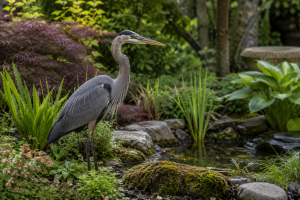
4. Herons Standing in Your Garden: You Have Water Nearby — and Probably Frogs
A Great Blue Heron standing motionless in a garden bed or at the edge of a pond is one of Victoria’s most striking wildlife encounters. Herons are patient, solitary hunters and they will stand completely still for twenty minutes waiting for movement before striking.
If a heron is visiting your yard, you almost certainly have a water feature, a rain garden, or a naturally damp low spot that is supporting frog and fish populations. Herons will absolutely clean out a garden pond of goldfish or koi given the opportunity, so if you have a decorative pond, a heron net or motion-activated deterrent is a worthwhile investment.
On the other side of the coin, regular heron visits to a naturalistic rain garden or damp planted area are a sign that your landscape is supporting a food web — frogs, insects, and small aquatic life are all present and active.
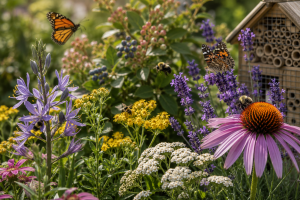
5. Bees and Butterflies Everywhere: Your Planting Choices Are Working
A yard buzzing with native bees and fluttering with butterflies through spring and summer is one of the clearest signs that your landscape is genuinely functioning as habitat rather than just looking good.
Native bees — Mason Bees, Bumblebees, and Sweat Bees are all common across Victoria — are far more effective pollinators of local plant species than European Honeybees. They are also more sensitive to pesticide use, soil disturbance, and the loss of nesting habitat. A healthy native bee population in your garden means your soil is reasonably healthy, your planting choices include species they can use, and your maintenance approach is not working against them.
For Victoria properties, the plants that consistently attract the widest range of pollinators include Camas, Oregon Grape, Salal, Yarrow, Lavender, and Echinacea. If you see Mason Bees specifically, they are nesting in small cavities nearby — wood piles, hollow stems, and bee houses all provide the habitat they need.
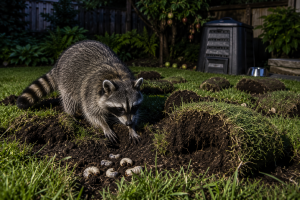
6. Raccoons Tearing Up Your Lawn: Same Message as the Crows
Raccoons digging up lawn at night is one of the most common complaints we hear from Victoria property owners through spring and summer. Like crows, raccoons are not the original problem. They are responding to one. In the vast majority of cases, nocturnal lawn digging by raccoons in Victoria points directly at a European Chafer Beetle grub infestation beneath the turf.
Raccoons are remarkably strong for their size and will methodically roll back sections of lawn to access grubs underneath. The resulting damage can be dramatic overnight. If you are finding rolled-up turf sections in the morning, check whether the grass peels back easily from the soil. If it does, the root system has been severed by grubs and treatment is needed.
Raccoons will also visit properties with accessible compost, pet food left outside, or fruit trees with dropped fruit. Secure compost systems, bringing pet food inside at night, and cleaning up fallen fruit promptly are the most effective deterrents.
7. Chickadees and Sparrows Year-Round: Your Garden Has Structure
Black-Capped Chickadees and Song Sparrows are two of Victoria’s most reliable year-round garden birds, and their consistent presence in a yard is a sign that the landscape has genuine structure — layered planting with shrubs, dense borders, and areas that provide shelter and foraging opportunities across the seasons.
Chickadees are highly active insect hunters through spring and summer and switch to seeds through fall and winter. A garden with dense shrub layers, berry-producing plants, and areas where seed heads are left standing through winter will support them year-round. Sparrows nest in dense, low shrubby areas and forage through leaf litter and mulched beds for insects and seeds.
If chickadees and sparrows are regulars in your yard, your landscape is providing more than just aesthetic value. It is functioning as genuine urban habitat for species that are under increasing pressure from habitat loss across Greater Victoria.
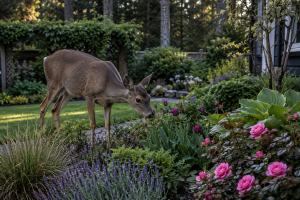
8. Deer Browsing Your Garden: Your Property Is on Their Route
Victoria’s urban deer population is a well-known feature of life across Saanich, Oak Bay, and the surrounding municipalities, and if deer are regularly browsing your garden, your property sits on an established movement corridor they use year after year. Uncover Victoria
Deer are browsers rather than grazers, meaning they selectively pick off specific plants while ignoring others. Roses, hostas, tulips, and vegetable gardens are high on their preference list. Lavender, rosemary, ornamental grasses, and most native plants with strong scents or fuzzy textures are far less appealing.
The most effective long-term response to deer pressure is not attempting to fence them out of an entire property — which is expensive and often only partially effective — but designing the planting around their preferences. IslandEarth has a dedicated post on deer-resistant plants that actually work in Victoria, covering exactly which species hold up and which ones get eaten regardless of what any plant tag claims.
Your Yard Is Part of Something Bigger
Victoria sits within one of the most biodiverse urban environments in Canada. Its combination of bird sanctuaries, coastal ecosystems, and mild year-round climate makes it a genuinely exceptional place for wildlife, and the landscapes that support that wildlife — even in small ways — are healthier, more resilient, and more interesting than the ones that don’t. Tourism Victoria
The wildlife showing up in your yard is giving you real, specific feedback about what your landscape is doing well and what it could do better. Paying attention to it is one of the most enjoyable ways to understand your property.
If you want help designing a Victoria landscape that works with the local ecosystem rather than against it, IslandEarth Landscape Company offers consultations across Greater Victoria.
Contact us today to get started.
📍 Serving Victoria, Saanich, Oak Bay, Langford, and surrounding communities
🌐 IslandEarth website
📞 (250) 474-1003