
How can FireSmart landscaping reduce wildfire risk in British Columbia?
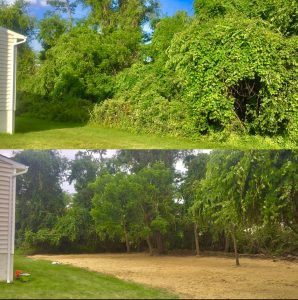
FireSmart landscaping reduces wildfire risk by limiting flammable plants, improving spacing, and using non-combustible materials around buildings. In Greater Victoria and across Vancouver Island, where summers are becoming hotter and drier, FireSmart design helps slow fire spread and reduce ignition risk during wildfire season.
1. What FireSmart Landscaping Is
What it is
FireSmart landscaping is a practical approach to designing and maintaining outdoor spaces so they are less likely to ignite or carry fire toward a structure.
Why it matters locally
While Victoria is coastal, it is not immune to wildfire risk. Dry summers, strong winds, and cured vegetation increase risk—especially near parks, greenbelts, and undeveloped land common across Vancouver Island.
IslandEarth example
IslandEarth crews often adjust planting layouts on residential and strata properties to reduce fuel loads while keeping landscapes functional and attractive.
Key FireSmart principles
-
Reduce flammable materials near buildings
-
Increase spacing between plants
-
Prioritize maintenance and moisture
2. FireSmart Zones Around Buildings
What it is
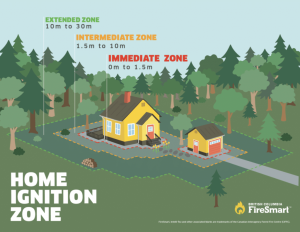
FireSmart BC divides properties into zones based on distance from structures, each with different risk levels and recommendations.
Why it matters locally
Many older Victoria homes have shrubs, bark mulch, or wood features directly against siding or decks—high-risk areas for ember ignition.
IslandEarth example
IslandEarth frequently upgrades the 0–1.5 m zone by replacing bark mulch and shrubs with gravel, stone, or irrigated lawn.
FireSmart zones table
| Zone | Distance | Focus |
|---|---|---|
| Zone 1 | 0–1.5 m | Non-combustible materials |
| Zone 2 | 1.5–10 m | Low-flammability plants |
| Zone 3 | 10–30 m | Thinning and spacing |
3. Choosing Fire-Resistant Plants
What it is
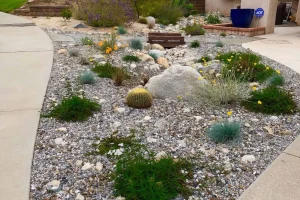
Fire-resistant plants are not fireproof, but they ignite more slowly due to higher moisture content and lower resin or oil levels.
Why it matters locally
Common plants like juniper, cedar hedges, and ornamental grasses dry out quickly during summer droughts.
IslandEarth example
IslandEarth often replaces resin-heavy shrubs with soft-leaf perennials that remain greener with less water.
Lower-risk plant traits
-
Broad leaves
-
Minimal sap or oils
-
Compact growth habits
4. FireSmart Plant List for Vancouver Island
What it is
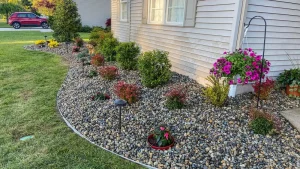
These plants align with FireSmart BC guidance and perform well in Zone 9b.
Why it matters locally
They tolerate dry summers while staying lower risk than many traditional landscape staples.
IslandEarth example
These plants are commonly used in IslandEarth residential and commercial projects.
| Plant | Type | Notes |
|---|---|---|
| Yarrow | Perennial | Drought-tolerant |
| Sedum | Groundcover | High moisture leaves |
| Lavender | Perennial | Use spaced, not massed |
| Hostas | Perennial | Ideal for shaded zones |
| Low Oregon Grape | Shrub | Better than cedar hedges |
5. Mulch: What to Avoid and What to Use Instead
What it is
Mulch choice has a major impact on fire behaviour near buildings.
Why it matters locally
Cedar bark mulch is widely used in Victoria but becomes highly flammable during dry periods.
IslandEarth example
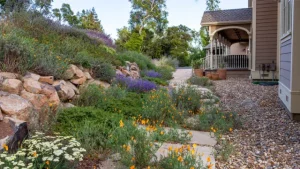
IslandEarth frequently replaces bark mulch within 1.5 m of structures with gravel or stone.
Mulch comparison
| Mulch Type | Fire Risk |
|---|---|
| Cedar bark | High |
| Shredded wood | Moderate–High |
| Compost (kept moist) | Lower |
| Gravel / stone | Very Low |
6. Lawn and Groundcover Management
What it is
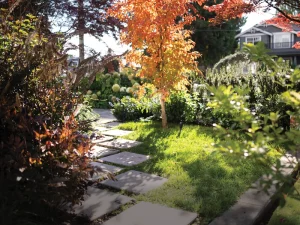
Maintained lawns can act as effective fire breaks.
Why it matters locally
FireSmart BC notes irrigated lawns are among the lowest-risk ground covers during fire season—important when following CRD watering rules.
IslandEarth example
IslandEarth adjusts mowing height and irrigation schedules to keep lawns green without wasting water.
Best practices
-
Mow regularly during dry periods
-
Remove cured clippings
-
Water efficiently within CRD rules
7. Spacing and Seasonal Maintenance
What it is
Spacing and upkeep are just as important as plant choice.
Why it matters locally
Rapid spring growth followed by dry summers can leave excess fuel if not addressed early.
IslandEarth example
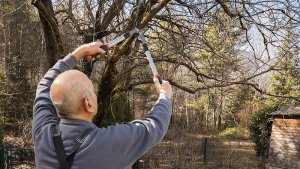
IslandEarth schedules thinning, pruning, and cleanup before peak fire season.
Maintenance priorities
-
Remove dead material
-
Increase plant spacing
-
Prune lower tree branches
8. Hardscaping as FireSmart Design
What it is
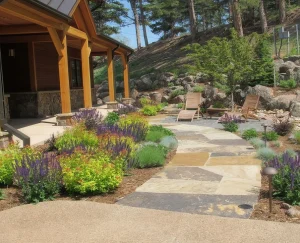
Hardscape features reduce available fuel and slow fire spread.
Why it matters locally
Stone and pavers also improve drainage in Victoria’s clay-heavy soils.
IslandEarth example
Projects often include stone pathways that act as both fire breaks and functional access routes.
Low-risk materials
-
Concrete
-
Pavers
-
Decorative gravel
9. FireSmart Landscaping for Strata & Commercial Sites
What it is
Larger properties require consistent standards across all areas.
Why it matters locally
Strata councils are increasingly responsible for wildfire mitigation near shared green spaces.
IslandEarth example
IslandEarth develops FireSmart-aligned maintenance plans for strata and commercial properties.
Strata checklist
-
Standardized plant palettes
-
Mulch guidelines
-
Scheduled cleanups
Mini FAQ
Is FireSmart landscaping mandatory in BC?
Not everywhere, but it is strongly recommended by FireSmart BC and local governments.
Are native plants always FireSmart?
No. Some native species are high risk in dry conditions.
Does gravel really reduce fire risk?
Yes. Non-combustible materials significantly lower ignition risk near buildings.
Quick FireSmart Checklist
-
Clear flammable plants within 1.5 m of structures
-
Replace bark mulch near buildings
-
Choose low-resin plants
-
Maintain lawns and remove dead growth
-
Prune and space shrubs and trees
IslandEarth CTA
IslandEarth designs and maintains FireSmart-aligned landscapes for homes, strata, and commercial properties across Greater Victoria. Free site check available.
FireSmart landscaping helps reduce wildfire risk during BC’s increasingly dry summers. By following FireSmart BC principles—choosing lower-risk plants, avoiding flammable mulch, maintaining spacing, and using non-combustible materials—Victoria homeowners and property managers can create safer, resilient landscapes without sacrificing appearance.