
Artificial intelligence isn’t just for tech companies anymore. In 2026, AI has quietly become one of the most powerful tools in commercial landscaping — helping crews work smarter, helping property managers spend less, and helping landscapes stay healthier through an increasingly unpredictable climate.
At IslandEarth Landscape Company, we serve commercial properties across Victoria, Saanich, Oak Bay, and Langford. We’ve watched this technology shift from a niche talking point to a genuine operational advantage. This post breaks down exactly how AI is being used in landscaping right now — and why it matters for properties on Southern Vancouver Island.
AI-Powered Irrigation: The Biggest Impact, Right Now
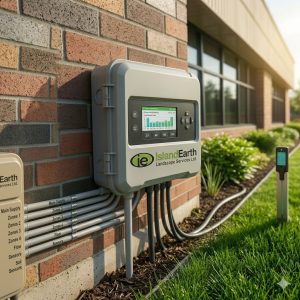
The most immediate application of AI in landscaping is irrigation — and the results are hard to argue with. Peer-reviewed research shows AI-driven irrigation delivers water savings of 30 to 50 percent compared to conventional timer-based systems. Scaped
For commercial properties in Victoria, that’s not a minor efficiency gain. It’s the difference between a water bill that stays flat through a dry July and one that climbs month after month.
Traditional irrigation systems run on fixed schedules. They don’t know if it rained last night. They don’t know that one corner of your property sits in a microclimate that dries out faster than the rest. AI-driven systems do. They pull in real-time weather data, read soil moisture sensors, and adjust automatically — watering only when and where it’s actually needed.
A large commercial property in Victoria, BC recently integrated an IoT-powered irrigation system. By utilizing smart soil sensors and weather-responsive irrigation controls, the property reduced water consumption by 40% while maintaining healthy, vibrant green spaces. Islandearthlandscape
That kind of performance is increasingly important as the CRD’s water conservation bylaw runs May through September every year — and BC’s drought seasons continue to intensify.
Predictive Plant Health Monitoring
Catching a problem after it’s visible is already too late. By the time a disease shows up in the leaves or a pest infestation becomes obvious, the damage is done and the replacement costs have already started climbing.
AI changes this equation. Continuous monitoring of plant health through sensors collects real-time data on moisture levels, nutrient content, and pest activity. Advanced analytics then alert landscape professionals to potential threats, enabling swift and effective action. Taylormadelandscapes
AI-powered sensors detect early signs of plant disease, soil depletion, and irrigation issues before they become significant problems — a proactive approach that helps landscapers address issues before they escalate, reducing maintenance costs and plant loss. Islandearthlandscape
For commercial strata properties and large institutional grounds, this kind of early warning system translates directly into fewer emergency service calls and more predictable maintenance budgets.
Smarter Design: AI Visualization and Site Analysis
Before a single plant goes in the ground, AI is already changing how landscape projects get planned and presented.
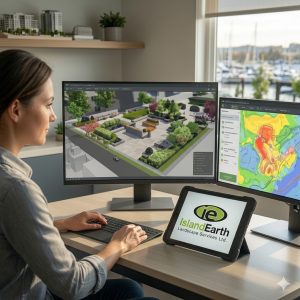
AI visualization tools generate photorealistic before-and-after images of a property using machine learning. Instead of asking a client to imagine what new plantings or hardscaping would look like, you show them. What used to take a designer several hours of manual work can now be produced in minutes. Scaped
On the analysis side, tools like Autodesk Forma use AI to evaluate environmental conditions before design decisions are made. Microclimate analysis simulates wind patterns, sun hours, and daylight potential — helping designers place seating areas and select appropriate plant species with far greater precision. Rendair
For Victoria properties, where microclimates vary significantly between sun-exposed south-facing slopes and shaded north-facing beds, this level of site intelligence makes a real difference in long-term plant success.
AI for Scheduling and Crew Efficiency
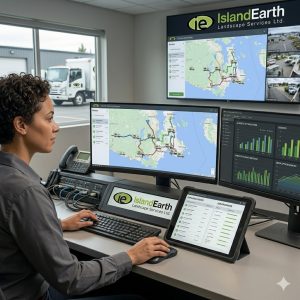
The operational side of landscaping is changing too. AI-driven job scheduling software and route optimization let smaller crews do more work, directly offsetting ongoing labor shortages — one of the most persistent challenges in the industry. FieldCamp
AI-driven scheduling systems ensure that maintenance teams work efficiently by predicting the best times for mowing, fertilizing, and pruning based on plant growth cycles and seasonal changes. Rather than following a generic calendar, crews work from data-informed schedules that respond to how the landscape is actually growing. Islandearthlandscape
For property managers, this means more consistent results and less variability in service quality from week to week.
Drone Technology and Site Monitoring
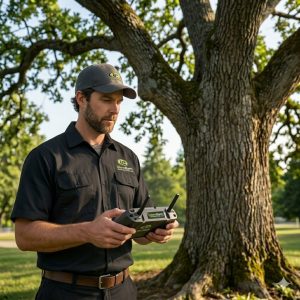
Drones equipped with AI are beginning to change how large sites get assessed and monitored. AI-equipped drones can create detailed 3D models of properties in a fraction of the time required by ground crews — identifying plant health, surface conditions, drainage issues, and construction materials in real time. Scaped
These drones analyze topographic maps with high accuracy, offering data on soil health, moisture levels, and vegetation types across a site — enabling landscape professionals to select the most appropriate plant species for specific microclimates within the larger area. Taylormadelandscapes
For larger commercial properties — corporate campuses, institutional grounds, and strata complexes with multiple buildings — drone assessments provide a level of site oversight that simply wasn’t practical before.
What This Means for Victoria Property Owners
AI in landscaping isn’t a replacement for skilled crews and experienced professionals. It’s a set of tools that makes both more effective. The properties that benefit most are those where a professional landscape company is deploying these tools strategically — matching the right technology to the right problem.
In Victoria’s context, that means:
Water compliance is easier to maintain. AI-driven irrigation keeps properties within CRD seasonal restrictions without requiring manual schedule adjustments every time the weather changes.
Landscape investments last longer. Predictive monitoring catches problems early, so plants that took years to establish don’t get lost to a preventable disease or pest outbreak.
Reporting and accountability improve. AI tools help landscape businesses increase efficiency and maximize performance — including site assessments, customer relationship management, and documented proof of work completed. NIP Group
Sustainability commitments become measurable. Water savings, reduced chemical use, and healthier soil health aren’t just talking points — they’re trackable outcomes that property managers can report to stakeholders.
IslandEarth Is Already Using These Tools
IslandEarth Landscape in British Columbia has begun incorporating AI-powered landscaping software to streamline operations and deliver superior landscaping services while reducing environmental impact. This isn’t future planning — it’s how we work today. Islandearthlandscape
If you manage a commercial property in Victoria and want to understand what AI-assisted landscape management could look like for your site, we’re happy to walk you through it.
Contact IslandEarth Landscape Company to schedule a consultation.