
Victoria gets over 600 millimetres of rain a year, most of it packed into the fall and winter months. For properties with a traditional solid patio, driveway, or walkway, that rain has nowhere to go except across the surface, often pooling in low spots or running straight toward the foundation. Permeable pavers solve this problem at the source, and they’ve become one of the defining hardscaping trends heading into 2026.
At IslandEarth Landscape Company, hardscaping is one of our core services across Victoria, Saanich, Oak Bay, and Langford. This guide walks through how permeable pavers work, when they make sense for a property, and how to choose the right system.
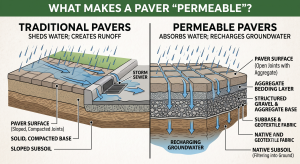
What Makes a Paver “Permeable”
A traditional paver patio or driveway is built to shed water — the surface is sloped and sealed so rain runs off into a drain or storm sewer. A permeable system works the opposite way. Permeable pavers facilitate the flow of rainwater through the paver joints into the subsoil below the paver base, using a structured base of gravel and aggregate rather than a solid, compacted pad. Instead of water pooling on the surface, it filters straight down into the ground beneath the pavers, recharging groundwater naturally rather than rushing toward a storm drain.
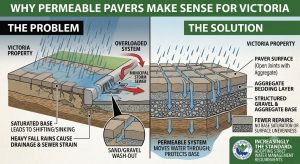
Why Permeable Pavers Make Sense for Victoria Properties
Stormwater management is a real local concern. Traditional pavers increase stormwater runoff, which can cause drainage problems and strain local sewer system capacity. In a city like Victoria, where heavy fall rain events are common, that runoff adds up fast across hundreds of properties.
Permeable systems also protect themselves over time. Without proper drainage, water saturates the base material beneath pavers, washing away sand and gravel and leading to uneven, shifting, or sinking surfaces. A permeable system is engineered to move water through rather than letting it pool against the base, which means fewer repairs down the road.
And it’s increasingly the standard rather than the exception. Municipalities are adopting stricter water management requirements, making permeable systems more common in residential driveways, patios, and walkways.
Step 1: Decide Where Permeable Pavers Make Sense
Permeable systems aren’t necessarily the right choice for every surface. They work especially well for driveways and parking areas with stormwater requirements, patios and pool decks prone to standing water, and walkways near mature trees, where permeable surfacing lets rainwater reach root systems that solid pavement would otherwise block. Areas with heavy vehicle traffic or steep grades need a properly engineered system rather than a basic dry-laid approach, which is where professional installation matters most.
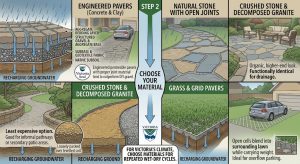
Step 2: Choose Your Material
Permeable concrete and clay pavers are engineered to look and feel like natural stone while managing stormwater, making them the most common choice for driveways and patios that see regular traffic. Natural stone with open joints offers a more organic, higher-end look, while staying just as functional for drainage. Crushed stone or decomposed granite, loosely packed over levelled soil, is the least expensive permeable option, a good fit for informal pathways or secondary patio areas. Grass and grid pavers, with open cells filled with soil and seeded, work well for overflow parking — they blend into the surrounding lawn while still carrying weight.
For Victoria’s climate specifically, materials that withstand repeated wet-dry cycles matter more than they would in a drier climate. Engineered permeable pavers with proper joint material tend to outperform DIY gravel installations over the long term.
Step 3: Get the Base Right
The visible surface gets all the attention, but the base underneath is what actually makes a permeable system work. A thick, compacted layer of open-graded crushed stone allows water to percolate through the system rather than pool, and the surface should still carry a gentle slope away from any structures, even as most water filters straight down through the joints.
This is also where professional installation earns its cost. Small patios under roughly 400 square feet with good existing slope can be reasonable DIY projects, but larger areas, flat sites, or properties with drainage problems benefit significantly from professional grading and equipment. Skimping on base depth is the most common reason for early failure of permeable installations.
Step 4: Plan for Long-Term Maintenance
Permeable systems need a different maintenance approach than solid pavement, though not necessarily a more demanding one. Permeable pavers should never be sealed, since sealing blocks the drainage function they’re designed to provide and creates ongoing maintenance the system wasn’t meant to need. Joint material gradually settles, so replenishing the joint stone roughly every 5 to 10 years helps keep everything flowing properly. A white, powdery residue called efflorescence sometimes appears shortly after installation as natural salts migrate to the surface — it isn’t a defect, and it fades with weathering. It’s also worth checking periodically for settling or tree-root movement and addressing small cracks before they become bigger problems.
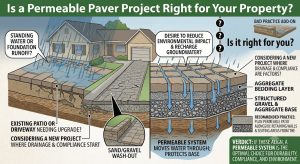
Is a Permeable Paver Project Right for Your Property?
Permeable pavers are a strong fit for properties in Victoria dealing with standing water on an existing patio or driveway, runoff directed toward a foundation, or a desire to reduce environmental impact while supporting local groundwater recharge. They’re also worth considering for any new driveway, patio, or walkway project where drainage and stormwater compliance are factors. And because hardscaping projects often expand over time, it’s worth planning a permeable patio alongside features like retaining walls or seating areas from the start, rather than adding them on later.
Let IslandEarth Build It Right
Hardscaping is one of IslandEarth Landscape Company’s core services, and permeable paver installation is exactly the kind of project where proper base preparation and material selection make the difference between a patio that lasts twenty years and one that needs rework within five.
Contact us today to schedule a hardscape consultation for your property in the Victoria area.
📍 Serving Victoria, Saanich, Oak Bay, Langford, and surrounding communities
🌐 IslandEarth website
📞 (250) 474-1003