
Summer in Victoria feels like a reward after a long Pacific Northwest winter — but for commercial landscapes, it’s also the most demanding season of the year. The heat arrives fast, the rain stops almost entirely, and CRD water restrictions take effect May 1st. Properties that aren’t prepared before the dry season hits will show it quickly: stressed turf, wilting shrubs, compacted soil, and mounting maintenance costs.
At IslandEarth Landscape Company, we maintain commercial properties across Greater Victoria through every season. This guide walks property managers and strata councils through the exact steps we take to get a landscape ready for summer — so it stays healthy, attractive, and low-stress through September.

Step 1: Soil Assessment and Amendment
Everything starts underground. Before summer heat sets in, understanding what your soil is actually doing — and correcting any deficiencies — makes every other step more effective.
Victoria’s soils vary considerably across the region. Many commercial properties in older neighbourhoods sit on compacted, heavy soils that drain poorly and hold heat unevenly. Others, particularly newer developments, have thin topsoil over fill material that dries out quickly and struggles to support healthy root systems.
A basic soil assessment looks at three things: compaction levels, pH balance, and organic matter content. Compacted soil prevents water from penetrating to root depth — meaning even a well-designed irrigation system can leave plants underwatered despite running correctly. Aerating compacted turf areas in late spring allows water and nutrients to reach root zones before the dry season begins.
If your pH is off, plants won’t absorb nutrients efficiently regardless of your fertilization program. Most ornamental plants and turf in Victoria perform best in slightly acidic to neutral soil, with a pH of roughly 6.0 to 7.0. A simple soil test — available through local garden centres or commercial soil labs — will tell you exactly where you stand and what amendment is needed.
Adding compost or a top-dressing of quality organic material in May replenishes organic matter lost over winter and improves moisture retention heading into the dry months. For properties with established garden beds, a 5- to 7-centimetre layer worked lightly into the top of the bed makes a measurable difference in how plants handle July heat.

Step 2: Mulching — The Single Most Effective Summer Prep Step
If there is one step on this list that delivers the most return for the effort, it is mulching. A properly applied layer of mulch does three things simultaneously: it retains soil moisture, regulates soil temperature, and suppresses weed competition.
For commercial properties in Victoria, mulch is especially valuable because it directly extends the interval between irrigation cycles. Bare soil exposed to summer sun loses moisture rapidly through evaporation. A 7- to 10-centimetre layer of quality mulch — wood chips, bark mulch, or composted material — can significantly reduce moisture loss, keeping soil cooler and plants healthier between watering events.
Application timing matters. Mulching too early, before the soil has warmed, can delay plant growth in spring. Late May to early June is the ideal window for Victoria properties — warm enough that soil temperature has risen, but early enough to protect against the July and August dry stretch.
Keep mulch pulled back from the base of shrubs and tree trunks. Mulch piled against stems and bark creates a moist, dark environment that promotes rot and attracts pests. A clear ring of 10 to 15 centimetres around each plant base is a small detail that prevents significant long-term damage.
For commercial properties with gravel or decorative stone areas, edging and refreshing stone beds in spring also help contain organic debris that breaks down and feeds weed growth throughout the summer.

Step 3: Strategic Pruning Before Heat Arrives
Spring pruning — done at the right time — sets plants up for a healthier growing season and reduces the stress of summer heat. Done at the wrong time, it can expose fresh cuts to drought conditions that the plant isn’t ready to handle.
The general rule for Victoria’s climate is to prune spring-flowering shrubs immediately after they finish blooming. Lilac, forsythia, and flowering currant all set next year’s buds shortly after bloom — pruning them too late removes the following season’s flowers. For non-flowering shrubs and hedges, a light shaping in late May before the growth flush slows gives them time to harden off before dry conditions arrive.
Trees are a different consideration. Structural pruning — removing dead, crossing, or compromised branches — is best done before summer heat stresses the tree. A tree dealing with drought stress has fewer resources to compartmentalize pruning wounds. Getting structural work done in May keeps wounds healing actively and reduces disease entry points during the season.
For commercial properties with formal hedges — cedar, laurel, and privet are common across Victoria — a full clip before June allows new growth to firm up and reduces the irrigation demand of a hedge, putting all its energy into flush new growth mid-summer.
One thing to avoid: heavy pruning of any plant during peak July heat. Removing a significant portion of the canopy during a heat event exposes previously shaded bark and branches, increasing the risk of sunscald. Any major pruning work should occur before peak heat or be scheduled for early September.

Step 4: Fertilization — Timing Determines Results
Commercial landscapes typically receive fertilization as part of a seasonal maintenance program, but the timing of summer applications can significantly affect outcomes.
A slow-release, balanced fertilizer applied in late May to early June provides turf and ornamentals with the nutrients they need to build root strength before the season’s water stress arrives. Nitrogen drives lush green growth that makes a property look well-maintained, but too much nitrogen applied in midsummer can produce rapid, soft growth that wilts in heat and requires significantly more water to sustain. The goal in summer is to support root development and stress tolerance — not to force aggressive top growth.
For turf specifically, a lower-nitrogen, higher-potassium formulation from July onward supports drought and heat tolerance far better than a standard balanced blend. Potassium strengthens cell walls and improves the turf’s ability to retain water. This is a refinement most homeowners won’t notice, but commercial properties — where turf quality is visible to tenants, clients, and the public — will see the difference through August.
Garden beds and shrub borders benefit from a light topdressing of slow-release granular fertilizer in late spring, avoiding application directly against plant stems. Compost applied in Step 1 reduces the amount of synthetic fertilizer needed and improves long-term soil health.
Step 5: Irrigation System Inspection and Programming
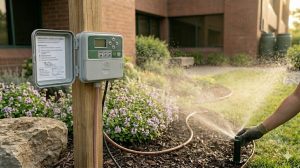
Before your irrigation system runs its first full cycle of the season, it needs to be inspected — not just turned on. A system that ran without issues last September may have developed problems over winter: frozen and cracked lines, shifted or damaged heads, clogged emitters, or a controller that lost its programming after a power interruption.
A spring irrigation inspection should confirm:
Coverage and head alignment. Walk the property with the system running zone by zone. Look for heads that are misting rather than producing a clean arc — this indicates pressure problems or worn nozzles. Confirm that coverage overlaps correctly and that no areas are being missed.
Drip line integrity. Drip systems serving garden beds and shrub borders are particularly vulnerable to damage from winter frost, rodents, and landscape work. Check emitters for blockages and replace any sections of line that show cracking or splits.
Controller programming. Update your seasonal schedule to reflect early-summer watering needs. Under Stage 1 CRD water restrictions, watering is permitted only during specified hours — program your controller accordingly from May 1st onward. Weather-based or soil-sensor-enabled controllers can handle these adjustments automatically, but a manual review each spring confirms the system is operating as intended.
Backflow preventer function. This is a compliance requirement under Victoria’s water bylaws, not just a best practice. Confirm it is functioning before the irrigation season begins.
A professional irrigation inspection at the start of the season typically identifies and corrects small issues before they become mid-summer failures — when fixing them is more disruptive and the consequences of underwatering are more severe.
Step 6: Pest and Disease Prevention Before the Season
Summer heat and dry conditions create the right environment for a number of common landscaping pests and diseases in Victoria. Getting ahead of them in late spring is far more effective — and less costly — than treating an active outbreak in July.
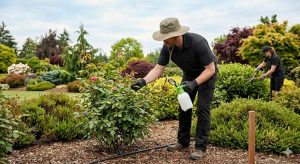
Aphids, spider mites, and scale insects all tend to proliferate in dry, hot conditions. A spring inspection of high-value shrubs and ornamentals, looking for early signs of infestation in new growth, enables targeted intervention before populations establish. For commercial properties under BC’s Integrated Pest Management Act, this means using physical removal, horticultural soap, and other approved low-risk products — not broad-spectrum synthetic pesticides.
Fungal diseases are a different challenge. Cool, wet springs followed by dry heat can leave plants in Victoria vulnerable to powdery mildew and other fungal issues, particularly on roses, lilacs, and densely planted shrubs. Good airflow through selective pruning reduces fungal pressure. Avoiding overhead watering and shifting irrigation to root-zone delivery — drip or low-angle sprinklers — removes the leaf-surface moisture that fungal diseases depend on.
For commercial properties with significant tree assets, a spring arborist assessment is worth the cost. Heat stress, late-frost events, and root-zone compaction from foot traffic all compound over time. An arborist can identify trees under stress before structural failure or decline becomes visible from ground level.
Putting It Together: A Pre-Summer Landscape Checklist
Here is a condensed version of the steps above, ready to use as a property walkthrough checklist before June ends:
- Soil tested and amended where needed
- Compacted turf areas are aerated
- Garden beds top-dressed with compost
- Mulch applied at a depth of 7 to 10 cm, pulled back from plant bases
- Spring-flowering shrubs pruned after bloom
- Structural tree pruning is complete
- Hedges shaped before the summer growth slowdown
- Slow-release fertilizer applied to turf and borders
- Irrigation system inspected zone by zone
- Controller programmed for Stage 1 CRD watering schedule
- Backflow preventer confirmed operational
- Early pest and disease signs were checked on key ornamentals
Let IslandEarth Handle It For You
Pre-summer landscape preparation is a significant amount of coordinated work — soil, mulch, pruning, irrigation, fertilization, and pest management all happening in the same four to six-week window. For commercial property managers and strata councils across Victoria, Saanich, Oak Bay, and Langford, this is exactly the kind of service IslandEarth Landscape Company provides as part of our seasonal maintenance programs.
Contact us today to schedule a pre-summer walkthrough of your property and find out what a properly prepared commercial landscape looks like heading into July.