
Moving into a new build is exciting. The house is done, the keys are in your hand, and the yard is a blank canvas. But that blank canvas is almost never as straightforward as it looks. New construction lots in Greater Victoria come with a specific set of challenges that can catch homeowners off guard if they go into the landscaping process without knowing what to expect.
At IslandEarth Landscape Company, new construction landscaping is one of our core services across Victoria, Saanich, Oak Bay, Langford, and surrounding communities. Here is what every new build homeowner should understand before a single plant goes in the ground.
1. Your Builder’s Grading Is a Starting Point, Not a Finished Product
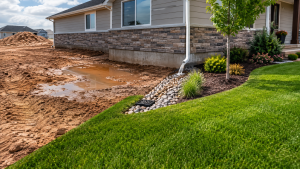
Builders must rough-grade new construction lots before handover — but rough grading is exactly what the name suggests. It is the minimum required to get water draining away from the foundation and the site to a passable condition. It is not optimized for landscaping.
Builders rough-grade new construction lots, but that doesn’t mean the grade matches your landscaping plans. What works adequately for construction often creates headaches for a finished landscape—low spots that pool water, slopes that are too steep for a usable lawn, and drainage patterns that send water toward fences or property boundaries rather than away from them.
Drainage issues usually become clear after the first rainstorm at your new house. You may see puddles in your yard or pooling around your home’s foundation. Identifying and correcting grading problems before you invest in lawn, planting, and hardscaping saves significant money compared to regrading after everything is already installed.
A professional site assessment before landscaping begins will identify whether the existing grade is workable or needs corrections, and whether drainage infrastructure such as catch basins or French drains is required.
2. The Soil on Your Lot Is Probably Not Suitable for Planting
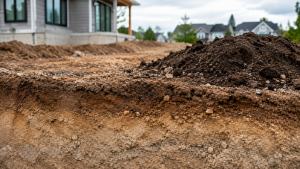
This is the most common surprise for new-build homeowners, and it catches people out every time. The soil on a new construction lot looks like soil—but it almost certainly isn’t topsoil, and it isn’t ready for planting.
Contractors often bring in fill dirt to elevate new homes, fill depressions, and create a slope that lets water flow away from the foundation. This fill dirt can come from many sources. It may include some topsoil, but more likely it is mostly subsoil from the immediate area or trucked in from elsewhere.
Fill dirt and subsoil are structurally useful for construction, but they do not support healthy plant or turf establishment. They are compacted, nutrient-poor, and often drain poorly. Grass seeded or sodded directly onto fill may look acceptable for a season, then decline as the shallow root system encounters the hostile conditions below.
Topsoil contains between 3 and 15 percent organic matter by dry weight — that organic content is what makes plants grow. For most Victoria new build lots, you need a minimum of 100 to 150 millimetres of quality topsoil over prepared subgrade before lawn installation, and garden beds require deeper soil preparation to support shrubs and perennials long-term.
3. Construction Compaction Is a Real Problem
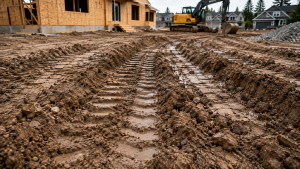
Every piece of heavy equipment that moved across your lot during construction compressed the soil beneath it. Excavators, concrete trucks, framing crews, trade vehicles — all of it creates compaction that goes well below the surface.
Equipment working over saturated clay creates deep ruts, compacts the subsoil beyond what is healthy for plant establishment, and produces a smeared, impermeable layer at the base of the disturbed zone that actually worsens drainage long-term.
Victoria’s clay soils are particularly vulnerable to this. When subsoil clay is compacted, it becomes nearly impermeable — water cannot move through it, roots cannot penetrate it, and the result is a yard that drains poorly despite appearing flat and open. Mechanical decompaction, typically through deep tilling or subsoiling before placing topsoil, is an essential step on most new-build lots, but it gets skipped far too often.
Any area where you plan to plant grass requires tilling to loosen the soil before planting. If you have a layer of compacted subsoil and are adding topsoil, till deeply enough to blend the two. Otherwise, your new lawn will not set down deep roots, which will weaken it.
4. Grading and Drainage Come First — Everything Else Follows
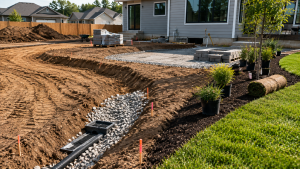
The sequencing of a new construction landscape installation matters enormously. Homeowners eager to get plants in the ground sometimes push to start with the visible, exciting elements—lawn, planting, maybe a patio—before properly addressing the grading and drainage foundation.
This always costs more in the long run. Getting the grade right is the foundation that everything else depends on. It determines whether your patio holds up for twenty years or starts cracking in five, whether your lawn thrives or drowns every spring, and whether the thousands of dollars you spend on plants and hardscape delivers lasting value.
The correct sequence for a new construction landscape installation is: site assessment and grading corrections first, drainage infrastructure second, soil preparation third, hardscaping fourth, and planting and lawn installation last. Doing it in this order means you are never ripping up a finished lawn to fix drainage underneath it.
5. Timing Matters More Than You Might Think
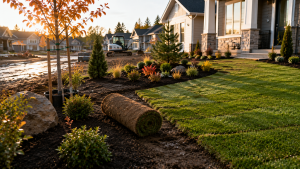
Victoria’s Zone 9b climate is genuinely forgiving by Canadian standards, but timing still matters for new construction landscaping, especially for lawn installation and tree and shrub establishment.
Spring is the most popular season for landscaping in Victoria, but fall is often the best time to start a new landscaping project. Plants establish roots more easily in cooler temperatures, and many companies have more availability.
For new construction specifically, fall planting has a distinct advantage: the fall rains arrive shortly after planting, reducing the irrigation demand during establishment and allowing root systems to develop through the cool, moist months of October, November, and December before summer heat arrives. Trees and shrubs planted in fall consistently establish more strongly than those planted in spring on new build lots, where soil conditions are often still settling.
Lawn is a slightly different calculation. Both spring and fall work well for seeding on Vancouver Island, but late August through mid-September is the best window — warm soil temperatures promote rapid germination, and fall rains take over irrigation naturally once growth begins.
6. Plan Irrigation Before You Plant
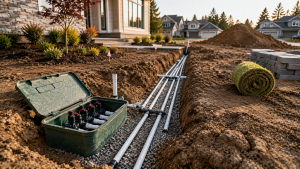
A new construction lot is the ideal moment to install irrigation infrastructure — before the lawn is established, before beds are planted, and before any hardscaping is in place. Trenching for irrigation lines through a bare lot is fast and inexpensive. Doing the same work through an established lawn and around mature plantings is disruptive and significantly more costly.
Even if you are not ready to install a full smart irrigation system immediately, roughing in the main lines and valve locations during the initial construction phase preserves the option without the disruption of digging it in later. Victoria’s dry summers make irrigation a practical necessity for most properties — particularly new build lots where plant material is establishing and has not yet developed the deep root systems that help mature plants handle dry periods.
At a minimum, confirm your irrigation plan before installing the lawn. Retrofitting irrigation into an established turf area means digging up work that is already done.
7. A Landscape Plan Saves Money — Even on a Simple Property
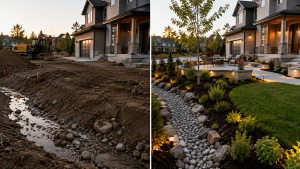
New build homeowners often approach landscaping incrementally — a bit of lawn now, some plants when the budget allows, maybe a patio eventually. This approach feels financially cautious but typically costs more over time than a sequenced plan developed upfront.
Many properties in Greater Victoria have slopes, shallow soils, or underlying bedrock. Grading, drainage corrections, soil improvement, and removing failing material all add time and cost but are often necessary to do the job properly. Knowing this upfront lets you sequence the work correctly and budget accurately. Discovering it after installation has started means rework.
A professional landscape plan for a new build does not have to mean committing to everything at once. It means understanding the full scope of what the site needs, establishing the foundational work — grading, drainage, soil, irrigation — in the right order, and then phasing the visible elements as budget allows. This approach consistently produces better results and costs less than the reactive, incremental alternative.
IslandEarth Builds New Construction Landscapes Across Victoria
New construction landscaping is one of IslandEarth Landscape Company’s core services. We work with new-build homeowners, developers, and construction companies across Victoria, Saanich, Oak Bay, and Langford to take lots from post-construction through to finished, professionally installed landscapes built to last.
Contact us today to schedule a site assessment and find out what your new build lot actually needs.
📍 Serving Victoria, Saanich, Oak Bay, Langford, and surrounding communities
🌐 IslandEarth website
📞 (250) 474-1003