
Insights inspired by the December 2025 Equipment Week article by Mike Jiggens
Robotic technology has been quietly reshaping the landscaping world for years, but 2025 marks the moment when autonomous mowers have officially stepped into the mainstream. As these machines become more intelligent, more efficient, and more capable, municipalities, sports facilities, and commercial property managers across Canada are taking notice. At IslandEarth Landscaping, we’re watching this evolution closely—not because robots will replace skilled landscapers, but because they offer exciting new tools to elevate turf care, improve efficiency, and support long-term sustainability.
A recent article by Mike Jiggens, published during Equipment Week, provides valuable insight into how far autonomous mowing has come. Using that article as a jumping-off point, here’s what the newest innovations mean for large-scale turf management in Greater Victoria and surrounding regions.
Screenshot
Technology That’s Advancing Faster Than Ever
One of the most notable points highlighted in Jiggens’ article is the dramatic improvement in mower intelligence. He writes that:
“Technological improvements continue to allow autonomous mowers to evolve… allowing for more efficient mapping, and lower mowing heights.”
This reflects a major shift in how modern mowers understand and navigate the terrain. Better mapping means cleaner, more consistent mowing patterns, while adjustable cutting systems allow robots to maintain everything from sports turf to finely manicured commercial lawns. Manufacturers are still improving these machines year after year—a pace that directly benefits commercial properties wanting the cleanest, most reliable results.
Cody Cook, a tech and robotics specialist quoted in the article, captures this ongoing evolution well:
“Even though we’re happy with it, we want to try to make it better.”
At this rate, the models coming over the next few years may offer capabilities we haven’t even imagined yet.
A New Level of Efficiency: Mowing While You Sleep
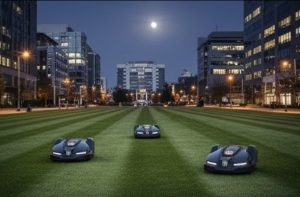
One of the biggest game changers for commercial spaces is the ability to mow overnight. Jiggens quotes Cook explaining that autonomous units are designed to run when sites are empty:
“The idea is you’re using this in the middle of the night when nobody’s around, so you can let it cycle, let it run.”
For businesses, schools, and athletic fields, this is a huge benefit. Instead of interrupting daytime operations or closing access to fields, mowing can now happen silently during off-hours. By morning, the lawn is freshly cut and ready for use—no downtime, no disruption, and no noise impact.

Helping Solve Labour Shortages Without Reducing Quality
Labour shortages continue to affect the landscaping industry, especially on large turf sites that require frequent mowing. Robotic units help close that gap by handling predictable, repetitive mowing tasks, freeing skilled landscapers for detail work and specialized care. As the article notes, one of the biggest advantages is that these machines:
“never call in sick.”
That’s not a replacement for skilled crews—it’s a strategic tool that expands their capacity.

Safety and Theft Prevention Built for Commercial Sites
Autonomous mowers are surprisingly secure. Jiggens explains that if someone tries to steal one:
“a mower taken from a field and placed in the back of a truck would trigger an alarm… its GPS-tracking safeguards allowed it to be recovered in only a few hours.”
Combined with obstacle-detection sonar and automatic shutdown features, these units offer safe, controlled operation in public spaces—an essential consideration for municipalities, schools, and recreational properties.
Designed for Real-World Weather and Conditions
One detail especially relevant to Vancouver Island comes from Paul Turner, also quoted in the article, who notes that these mowers can continue working even in wet conditions:
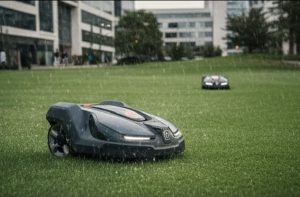
“You can mow in the rain. It’s not afraid of the rain.”
With long wet seasons in BC, equipment that can stay productive year-round is a huge advantage. Turner also highlights the wide range of models available—including versions capable of handling slopes up to 60 degrees—making it easier to match the right machine to the right landscape.
Better Turf, Less Waste, and a Healthier Environment
Frequent micro-mulching is one of the biggest hidden benefits of robotic mowing. Because the mowers trim only small amounts at a time, the clippings break down quickly, enriching the soil naturally. As the article points out:
“The nutrients going back down will produce a better stand of turf for you.”
This creates healthier, denser, more resilient lawns—while reducing fertilizer use and irrigation needs.

The Bottom Line for Greater Victoria
Autonomous mowing is not just a trend—it’s a practical, sustainable, and cost-effective approach to maintaining large commercial landscapes. Whether for sports fields, business parks, schools, or municipal grounds, these machines offer consistency, reliability, and long-term value.
IslandEarth Landscaping is committed to staying at the forefront of these innovations. If you’re curious about whether robotic mowing could be integrated into your property maintenance plan, our team is here to help you explore the options and build a program that fits your landscape’s needs.