
Short answer:
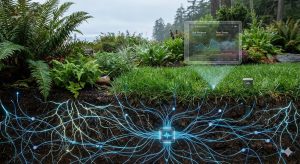
Landscapes already behave like living organisms—but most are managed as if they’re static. By treating sensors as nerves, AI as the brain, and crews as the hands, landscapes on Vancouver Island can feel stress early and respond to water issues, soil fatigue, and traffic pressure before visible damage appears.
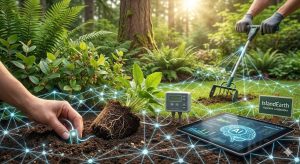
1️⃣ Landscapes Are Living Systems (Even If We Treat Them Like Objects)
What it is:
Soil, turf, and plants constantly respond to moisture, temperature, pressure, and nutrients. Roots and soil biology register stress long before leaves turn yellow or lawns thin.
Why it matters on Vancouver Island:
In Zone 9b, mild winters and frequent rain often hide early warning signs. By the time damage is visible, issues like compaction or root suffocation are usually well underway—especially in clay-heavy Victoria soils.
IslandEarth example:
IslandEarth frequently identifies irrigation or drainage issues weeks before clients notice changes above ground, simply by reading soil behavior—not appearances.
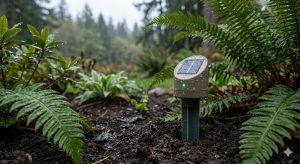
2️⃣ Sensors = The Landscape’s Nerves
What it is:
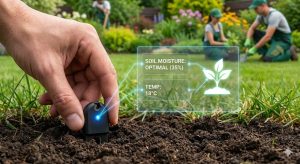
Soil moisture sensors, temperature probes, and rain gauges act like nerve endings, sending real-time signals about what’s happening underground.
Why it matters locally:
With CRD watering restrictions and inconsistent rainfall, overwatering can be just as damaging as drought. Sensors prevent both by responding to actual conditions.
IslandEarth example:
On strata properties, IslandEarth uses zone-level data to avoid one courtyard being waterlogged while another struggles.
| Sensor | Detects |
|---|---|
| Soil moisture | Saturation or drought |
| Soil temperature | Root activity timing |
| Rain sensors | False irrigation triggers |
3️⃣ AI = The Brain Interpreting Stress
What it is:
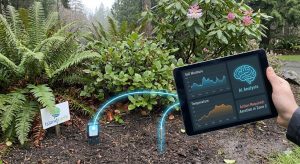
AI analyzes sensor data alongside weather patterns and site history to determine when action is truly needed.
Why it matters in Victoria:
Traditional calendar-based care ignores local conditions. AI adjusts decisions based on reality—not dates.
IslandEarth example:
IslandEarth times fertilization and aeration using soil temperature thresholds, improving nutrient uptake and reducing runoff.
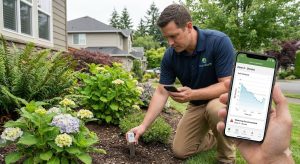
4️⃣ Crews = The Hands That Respond
What it is:
Skilled crews perform targeted interventions instead of blanket maintenance.
Why it matters locally:
Labour and materials are costly. Precision work reduces unnecessary visits while protecting stressed areas early.
IslandEarth example:
Rather than aerating entire lawns, IslandEarth focuses on high-traffic zones where compaction data shows pressure building.
5️⃣ Feeling Water Stress Before Root Rot Appears
What it is:
Overwatered soil loses oxygen, stressing roots long before turf fails.
Why it matters on the Island:
Victoria’s soils drain slowly. Excess moisture often goes unnoticed until turf collapse or fungal issues appear.
IslandEarth example:
Sensor alerts allow IslandEarth to pause irrigation days earlier than visual inspection would allow.
6️⃣ Detecting Soil Fatigue Before Growth Slows
What it is:
Repeated use without recovery compresses soil, limiting air, water, and nutrient movement.
Why it matters locally:
Commercial entries and strata lawns experience year-round foot traffic due to mild weather.
IslandEarth example:
IslandEarth schedules restorative aeration when soil conditions are biologically ready—not just “spring or fall.”
7️⃣ Human Traffic Is a Stress Signal
What it is:
Foot traffic patterns reveal where landscapes are under pressure.
Why it matters in Victoria:
Landscapes here don’t get long off-seasons. Continuous use requires continuous monitoring.
IslandEarth example:
IslandEarth uses traffic data to reinforce turf or redirect movement before damage occurs.
8️⃣ From Reactive Fixes to Preventive Care
What it is:
A nervous-system approach shifts landscaping from reacting to failures to preventing them.
Why it matters locally:
Preventative care aligns with sustainability goals promoted by Capital Regional District and resilience guidance from FireSmart BC.
| Reactive | Preventative |
|---|---|
| Replace dead turf | Prevent root stress |
| Emergency repairs | Planned interventions |
| Excess water use | Condition-based irrigation |
Mini FAQ
Is this only for large sites?
No. Smaller residential systems can use scaled-down monitoring.
Does AI replace landscapers?
No. It helps crews act with precision.
Does it save money?
Yes—by reducing repairs and wasted inputs.

Quick Checklist
-
Monitor soil moisture by zone
-
Track soil temperature, not just seasons
-
Watch compaction in high-traffic areas
-
Adjust irrigation to real conditions
-
Focus on preventative care
IslandEarth CTA
IslandEarth manages landscapes based on how they actually feel. Free site assessments available across Greater Victoria.
Final Summary
If landscapes had a nervous system, they wouldn’t wait to fail before asking for help. By combining sensors (nerves), AI (the brain), and skilled crews (the hands), landscapes across Victoria and Vancouver Island can respond to stress early—saving water, protecting soil, and extending the life of every plant. This is the future of professional landscaping: preventative, responsive, and built for Island conditions.