
Yes, AI can now predict which parts of your landscape will fail before damage occurs. By analyzing terrain data, soil types, and local weather patterns on Vancouver Island, algorithms can rank “risk zones” on your property. This allows homeowners and strata managers to move toward a “failure-first” design model—fixing drainage and tree hazards before spending a dime on expensive aesthetic upgrades.
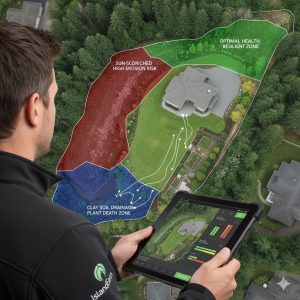
1. AI Ranking of Property Risk Zones
-
What it is: AI software uses satellite data and topographical mapping to create a “heat map” of your yard, identifying where problems are mathematically likely to occur.
-
Why it matters: In Greater Victoria, our dramatic elevation changes mean one side of your property might be a sun-scorched rock shelf while the other is a swampy clay basin. AI identifies these zones so you don’t plant expensive specimen trees in a “death zone.”
-
IslandEarth Example: Before starting a large-scale planting in Langford, we can analyze slope data to ensure we aren’t placing water-sensitive shrubs in a natural runoff channel.
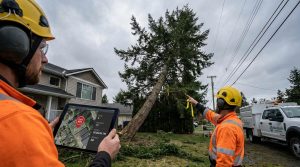
2. Predicting Tree Health and Structural Failure
-
What it is: Algorithms analyze tree species, lean angle, and proximity to power lines or buildings to predict “hazard potential” during storm events.
-
Why it matters: With BC Hydro reporting more frequent wind-related outages, knowing which Douglas Fir or Garry Oak is likely to drop a limb in a January gale is vital for safety. AI looks at historical wind tunnels specific to neighbourhoods like Fairfield or Gordon Head.
-
IslandEarth Example: We use site data to prioritize “preventative pruning” of trees flagged by the algorithm as high-risk, rather than waiting for a branch to hit a roof.
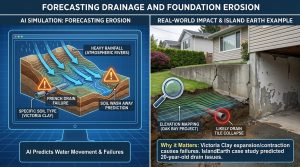
3. Forecasting Drainage and Foundation Erosion
-
What it is: AI simulates heavy rainfall (atmospheric rivers) to see how water moves across your specific soil type, predicting where French drains will fail or where soil will wash away.
-
Why it matters: Much of the Island sits on “Victoria Clay,” which expands and contracts. AI can predict when this movement will cause retaining walls to fail or basement dampness to begin.
-
IslandEarth Example: On a recent Oak Bay project, we used elevation mapping to show a strata council exactly where their 20-year-old drain tiles were likely to collapse under the next big storm.
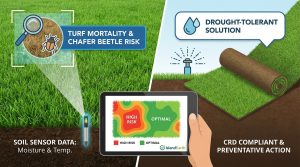
4. Identifying Turf Mortality and Chafer Beetle Risk
-
What it is: By monitoring soil temperature and moisture levels, AI can predict which sections of your lawn will turn brown first or become a buffet for the European Chafer Beetle.
-
Why it matters: CRD watering rules limit your ability to “rescue” a dying lawn in July. AI tells us where to install drought-tolerant turf blends before the heatwave hits, so you don’t have to replace your entire lawn.
-
IslandEarth Example: We use moisture sensors to inform our maintenance plans, targeting aeration only where the soil is “compacted” based on the data.
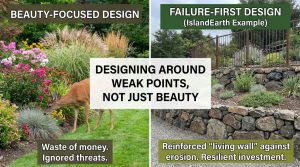
5. Designing Around Weak Points, Not Just Beauty
-
What it is: “Failure-First” design means the architect considers the worst-case scenario (fire, flood, or deer) and builds the garden to withstand those specific threats.
-
Why it matters: It is a waste of money to design a beautiful garden that a deer will eat in one night. Following FireSmart BC guidelines and AI deer-pressure maps ensures your investment lasts more than one season.
-
IslandEarth Example: Instead of just a “pretty hedge,” we might design a reinforced “living wall” that solves a predicted erosion issue while also looking great.
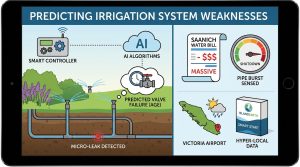
6. Predicting Irrigation System Weaknesses
-
What it is: Smart controllers and flow sensors use algorithms to detect “micro-leaks” and predict which valves are likely to fail due to age or mineral buildup.
-
Why it matters: An undetected leak in Saanich can lead to a massive water bill. AI can shut down your system the second it “senses” a pipe burst that hasn’t reached the surface yet.
-
IslandEarth Example: Our “Smart Start” packages include controllers that adjust daily based on hyper-local weather data from the Victoria airport station.
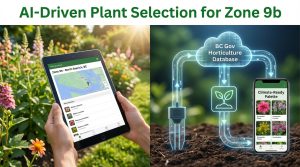
7. AI-Driven Plant Selection for Zone 9b
-
What it is: AI cross-references your soil pH with the BC Gov horticulture database to select plants that are biologically “programmed” to thrive in your specific backyard micro-climate.
-
Why it matters: A plant that lives in North Saanich might die in Sooke due to salt spray or wind. AI removes the “guesswork” from the nursery visit.
-
IslandEarth Example: We suggest “Climate-Ready” palettes—plants that the algorithm confirms can handle the wet winters and bone-dry summers of the Island.
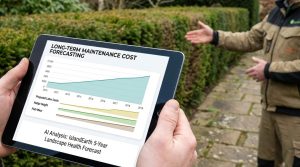
8. Long-Term Maintenance Cost Forecasting
-
What it is: AI calculates the future labour costs of a landscape design, predicting when a hedge will become too tall to manage or when a path will become a slip hazard.
-
Why it matters: For property managers, this is a budget lifesaver. It enables “Sinking Fund” planning based on actual wear-and-tear data rather than guesswork.
-
IslandEarth Example: We provide strata boards with a 5-year “Landscape Health Forecast” so they can save for major pruning or bark mulch refreshes before the site looks neglected.
The “Failure-First” Property Checklist
| Risk Factor | What AI Predicts | The Fix |
| Wind Storms | Which branches will fall first | Crown thinning/Weight reduction |
| Heavy Rain | Where water will pool/flood | Rain gardens or French drains |
| Soil Heat | Which plants will wilt first | Mulching and drought-tolerant species |
| Deer Pressure | High-traffic “deer highways” | Deer-resistant fencing or planting |
| Sinking Stones | Where pavers will shift/sink | Deep-base compaction and geogrid |
Mini FAQ
-
Does AI mean I don’t need a gardener? No. AI is the “X-ray,” but the landscaper is the “Surgeon.” You still need skilled hands to do the work.
-
How does AI know about my soil? It uses historical geological data from the BC Ministry of Environment, combined with your specific site’s drainage performance.
-
Is this expensive? Proactive design is actually cheaper. Fixing a fallen tree is 4 times as expensive as pruning it before it falls.
Quick Checklist: Action Items for Property Managers
-
[ ] Map out your property’s “Low Points” during the next heavy rain.
-
[ ] Identify any tree leaning toward a structure or power line.
-
[ ] Check your last water bill for “hidden leaks” compared to last year.
-
[ ] Replace one “high-maintenance” plant with a native, AI-recommended species.
-
[ ] Schedule a “System Audit” to find hardware weak points.
Summary
For homeowners and managers on Vancouver Island, the future of landscaping isn’t just about what looks pretty—it’s about what survives. By using AI to predict failures in drainage, tree health, and soil stability, we can design gardens that are resilient to our unique Zone 9b climate. Instead of reacting to a flooded basement or a fallen oak, a “failure-first” approach allows you to invest your budget where it matters most, ensuring your property remains safe, beautiful, and valuable for decades to come.