
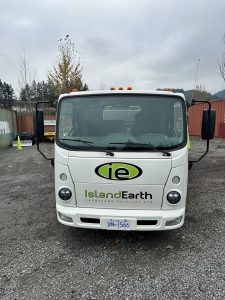
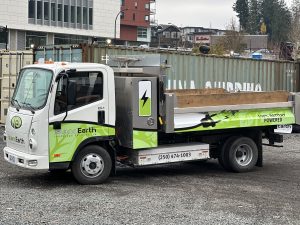
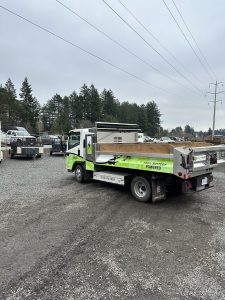
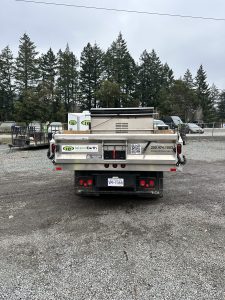
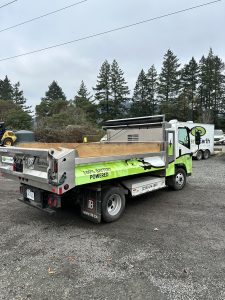
As we welcome the third year with our IslandEarth Landscape EV Dumper, I feel both proud and frustrated. On one hand, this white and lime-green truck represents everything we hoped electric vehicles could be: reliable, cost-effective, and genuinely better for the environment we’ve committed to protecting. On the other hand, its presence also highlights a problem we can no longer ignore.
Over the past two years, the results have been clear. We’ve handled minimal repairs beyond routine upgrades. In addition, we’ve reduced operating costs and eliminated tailpipe emissions entirely. By every meaningful metric, this truck has been a success.
So why, despite all of this, do we still have only one?

The Paradox of Success
At first glance, the answer doesn’t make sense. EV launch events and sustainability reports consistently celebrate progress. However, what they rarely acknowledge is the infrastructure gap facing commercial vehicles.
Specifically, the charging infrastructure needed to scale electric work trucks doesn’t exist on Vancouver Island. Not onlyis it absent in Victoria, but it’s also missing throughout Nanaimo, Courtenay, Campbell River, and the surrounding regions where our crews operate daily.
In theory, IslandEarth could operate six to ten electric trucks like this one. In practice, we should already be running at least six. The business case is solid. Moreover, the environmental imperative is undeniable. Most importantly, the technology works.
Yet, we can’t scale. Because of this, the success of one truck remains isolated instead of transformative.
The Infrastructure Gap No One Talks About
In September 2025, BC Hydro completed the Electric Highway across Vancouver Island. As a result, drivers can now travel from Victoria to Port Hardy with reliable charging access. For passenger vehicles, the system performs well.
However, the experience changes immediately when a commercial truck enters the equation. For example, parking stalls are designed for compact vehicles, not flatbeds or trucks pulling equipment. Meanwhile, charging speeds that suit a coffee stop for a sedan fall short for a working vehicle on a tight schedule.
Even more critically, station locations prioritize commuter and tourist corridors. As a result, industrial areas, nurseries, and active work zones remain underserved. In many cases, trucks can technically charge—but physically cannot fit.
Consequently, commercial fleets remain locked out of infrastructure that appears complete on paper.
Why This Problem Remains Invisible
Unfortunately, this gap rarely makes headlines. Battery breakthroughs generate excitement. Celebrity EV purchases attract attention. Meanwhile, the mundane reality of infrastructure design receives little notice.
Because of this, progress appears stronger than it actually is. While passenger EV adoption accelerates, commercial electrification lags, not due to technology limitations, but because the system ignores how working vehicles operate.
The Emissions We’re Leaving Behind
To understand the scale of the issue, consider what this limitation costs. Five additional EV trucks would eliminate approximately 50–75 tonnes of CO₂ annually from our operations alone. In other words, each truck could remove 10–15 tonnes of emissions per year.
Now, multiply that across landscaping companies, delivery services, construction firms, and trades businesses across Vancouver Island. Collectively, thousands of tonnes of emissions could be eliminated today.
Instead, they persist—not because solutions don’t exist, but because infrastructure prevents adoption.
Municipalities already recognize the value. For instance, the City of Colwood deployed an electric medium-duty truck in May 2025. However, isolated success stories don’t drive systemic change. To truly move forward, entire industries need accessible infrastructure.
Why Commercial Vehicles Keep Getting Left Behind
Part of the reason passenger EV charging receives more attention is simple: the market is larger and the politics are easier. If Level 2 chargers appear at condos and shopping centres, commuter needs are largely met. Likewise, highway fast chargers support long-distance travel.
By contrast, commercial vehicles operate under very different constraints. Routes are unpredictable. Furthermore, crews can’t afford multi-hour charging stops. When trucks stop, productivity stops too.
Because of this, commercial fleets require:
-
First, high-power DC fast charging capable of mid-shift replenishment
-
Second, strategic placement near industrial parks and work routes
-
Third, truck-friendly layouts with pull-through bays
-
Finally, absolute reliability to avoid costly downtime
Without these elements, electrification remains impractical for working fleets.
The True Cost of Delay
Each year that commercial-grade charging is delayed compounds the damage.
Environmentally, fossil fuel use continues despite viable alternatives.
Economically, businesses lose access to lower operating costs and competitive advantages.
Strategically, the workforce trains on systems that are already becoming obsolete.
Socially, communities near industrial zones continue bearing preventable health impacts.
Taken together, these costs far outweigh the investment required to act.
What It Will Take to Break the Logjam
Clearly, this problem won’t resolve itself. As long as infrastructure lags, businesses hesitate. At the same time, developers hesitate without committed fleets.
To move forward, Vancouver Island needs:
First, purpose-built commercial charging designed for trucks, not cars.
Second, coordinated public-private partnerships that place charging where trucks work.
Third, regional fleet collaboration to anchor shared charging hubs.
Finally, clear standards and timelines that allow confident planning.
Above all, we need honest metrics that acknowledge commercial vehicles as a core part of the emissions equation.
The View From Year Three
Today, standing beside our EV dumper, the conclusion is unavoidable. The technology works. The business case holds. Moreover, clients respond positively when sustainability aligns with professionalism.
Still, one truck represents a pilot—not a transformation. In contrast, six trucks would signal real change.
Ultimately, the question isn’t whether commercial fleets can electrify. We already know they can. The real question is whether infrastructure will arrive in time to turn proven pilots into systemic progress.
Happy New Year. Now, let’s make this the year infrastructure finally catches up to commercial reality.